I can't believe I haven't mentioned this yet! One of my husband's favorite magazines is Herp Nation. He was even featured in a Herper Profile (in volume 1.2). I love Herp Nation Magazine because the articles are interesting and the photos are amazing. Here is their website <---clicky
We currently have a few of these magazines in our frog themed bathroom :)
Friday, September 2, 2011

Happy Birthday Dib!
Well, actually it was his birthday yesterday. Four years ago (and a day), my mom's neighbor found a litter of four tiny kittens. They were less than a day old, and they were abandoned. Something had attacked the kittens (we don't know what) and their mom was gone. One of the kittens had an injured paw, and another one had a piece of his ear torn off. The kitten with the injured paw died a few days later, but the other three survived. My cat was the one with the injured ear (you can kind of see the nick in his ear in the picture below).
For several months, my mom and I traded off getting up every few hours in the middle of the night (on school nights, I might add) to bottle feed and "clean up" the kittens. In case you didn't know, tiny kittens need to be stimulated in order to go to the bathroom (this is not a fun task. It involved a wet wash cloth, a screaming kitten, and a lot of poop). Raising kittens that young involved a lot of work and sacrifice. So while I normally wouldn't celebrate a cat's birthday, I really was their mother (in a weird sort of way), and so I do appreciate their birth. We didn't throw him a party or anything. I just gave him a couple of treats and called him "Birthday Boy" all day :)
For several months, my mom and I traded off getting up every few hours in the middle of the night (on school nights, I might add) to bottle feed and "clean up" the kittens. In case you didn't know, tiny kittens need to be stimulated in order to go to the bathroom (this is not a fun task. It involved a wet wash cloth, a screaming kitten, and a lot of poop). Raising kittens that young involved a lot of work and sacrifice. So while I normally wouldn't celebrate a cat's birthday, I really was their mother (in a weird sort of way), and so I do appreciate their birth. We didn't throw him a party or anything. I just gave him a couple of treats and called him "Birthday Boy" all day :)
 |
| Happy Birthday, Dib! |
Link Love: Women and Reptiles Article
I found a really cool article on the Reptile Channel website. It is about women and reptiles.
Here it is <---Clicky
Here it is <---Clicky
Blog Update
So I think that I have been a bit too general here. I decided to update the blog a little bit to be a little more focused. Women and reptiles (and amphibians and other animals, of course). I updated the "about us" page. I also updated some of the animal posts. Now, all animal care posts will be "Species Spotlights". I think I will still add things like recipes and wedding stuff. Why not? We are still a blog for women! We are just a little more slimy (and I think that is a good thing)!
Here is our new tag line: If you love the feel of a snake's skin, if you get excited when you find a tree frog, and if you think a salamander's smile is adorable, then this is the blog for you!
Here is our new tag line: If you love the feel of a snake's skin, if you get excited when you find a tree frog, and if you think a salamander's smile is adorable, then this is the blog for you!
Tuesday, August 23, 2011
RIP Reptar, Welcome Squeezie
So our terrestrial salamander, Reptar, passed away last week. We have had him for several years, and he was full grown when we got him, so we think he may have just died of old age. He was a really cool animal, and we will miss him dearly.
The day after Reptar passed, we went to the pet store to buy some crickets. Well, they had a ball python up for adoption. Her owner was moving and could no longer keep her. Long story short, we took the 7-year-old python home. Her name is Squeezie (named by her old owner). She is as sweet as a snake can be :) The picture below shows her in her old cage. We switched her cage with our corn snake's after cleaning them both out and adding carefresh.
 |
| RIP my dear pet |
The day after Reptar passed, we went to the pet store to buy some crickets. Well, they had a ball python up for adoption. Her owner was moving and could no longer keep her. Long story short, we took the 7-year-old python home. Her name is Squeezie (named by her old owner). She is as sweet as a snake can be :) The picture below shows her in her old cage. We switched her cage with our corn snake's after cleaning them both out and adding carefresh.
 |
| Welcome! |
Saturday, July 30, 2011
Species Spotlight: The Humble House Mouse
So I'll start off my animal care posts with an easy one. Mice! I worked at a commercial mouse breeding facility for a year, so I know quite a bit about these little critters. Mice are typically nice little animals. They are quiet, they don't take up much space, and they rarely bite.
Food and Water
The first priority for most animals is water. Rodents should get their water from an "on-demand" water bottle (one of those water bottles that drip water when the spout is licked or touched). Mice are very messy creatures, and they will quickly contaminate water left in an open dish. The on-demand bottle keeps the water clean. Make sure the bottle has water in it at all times, as mice cannot survive very long without water. If you notice that your mouse has a hunchback, it is probably dehydrated. Check that the water from the bottle is still flowing. As for food, I feed the mice a handful of packaged mouse food pellets every few days (or when I notice that they are out). As a treat, I give them dried papaya cubes (packaged specifically for mice). They also love meal worms and peanut butter. I tried giving the mice a food dish, but they just pooped in it and made a huge mess. I prefer just to place the handful of food pellets in the cage. The mice will probably take the food and hide it where they want it (mine do).
The Cage
Mice don't need a lot of space. A ten gallon glass aquarium is the perfect size for a pair of mice. I prefer glass because the mice can't kick out bedding and can't escape easily. However, you need to be careful with a glass tank because the ammonia levels (from the mouse's waste) can get high before you even smell a dirty tank. If you go with a typical rodent cage, make sure the mice can't squeeze through the bars. All cages should have a tight fitting lid and be free of holes to prevent any possible rodent escapes.
Bedding
You are going to hear this one a lot when I talk about my animals: If money wasn't an issue, I would use bright blue care fresh. It is a very absorbent bedding. It is pretty, and it absorbs odors pretty well. To save money, I use shredded paper instead (from my paper shredder). It does a pretty good job of absorbing waste and odors (not nearly as good as the care fresh), but it is free. I use enough to cover the bottom of the cage with about 1/2 in of bedding.
Toys
Mice are very playful, active creatures. They love to run on wheels and climb on things. I provide my mice with a wheel to run in, wooden blocks (packaged for rodents) to chew on, and toilet paper tubes and cardboard boxes to hide in. I love giving my mice toilet paper tubes because they are free and they can be thrown away. Anything in the mouse cage that doesn't get thrown away should be sanitized weekly. Which brings me to my next point...
Cleaning
Mice are messy! I clean my cage out once weekly with a bleach solution. You don't have to do this. You can change the bedding about once every week to two weeks, and completely clean the cage once a month. But I like to have a clean cage, so I throw it in the shower and hose it down (we have a detachable shower head, which makes cleaning up after animals a snap) once a week. I just put a splash of bleach in the cage with about a gallon of water and rinse it well.
Handling
You can handle your mouse often. The best way to pick them up (if they don't crawl into your hand) is to shoo them into a toilet paper tube, pick up the tube, and tilt the tube slightly so that the mouse crawls into your palm. A faster way to pick up a mouse is to grab it by the base of the tail (this is very important: Grab it by the base. If you grab it by the tip of the tail it could break off), and lift the mouse gently, supporting its body with your other hand. Unless you have a particularly mean mouse, your mouse shouldn't bite. It will, however, poop and pee in your hand. Be prepared for that :) As with any animal, it is always a good practice to wash your hands before and after holding your pet. It is especially important with mice to wash your hands after because their feces can carry salmonella.
Breeding
I currently own a breeding pair of mice. They pretty much take care of things on their own. The mama mouse will have about 2-6 babies(sometimes more) in a litter every 28 days or so. Mice can get pregnant soon after giving birth (within 24 hours), so it is important to take out the male if you do not want her getting pregnant again. The male can be in the cage with the pregnant female and the babies. Male mice are pretty uninvolved fathers, but they typically don't hurt the babies. Fair warning: The mama mouse may try to eat her babies. Unfortunately, this is just something that mice do. If your mama mouse tries to eat her babies, you can try making her environment calmer (reduce noise, put a blanket over the cage, don't touch the mice, etc). Also, you should make sure she is getting enough to eat (yes, some mice will eat their babies if they are starving). As my old boss told me, having babies is a learning process. Usually by the second or third litter, your mamma mouse will stop this behavior. Millie (my mouse) is a good mom. She has never tried to eat her babies. She will usually eat any stillborn babies (which is a great behavior).
Questions
Q: Do Mice Smell Bad?
A: The short answer is yes, mice are stinky. Male mice are smellier than female mice. If you have a breeding pair (like I do), your cage will be even smellier. But a single female mouse or a pair of female mice are not that stinky. A glass aquarium is the best cage for keeping the smell in.
Q: Do mice make good pets for children?
A: Yes. Mice make very good pets for older kids! I like mice a lot more than dwarf hamsters, which can be more timid and are more likely to bite (from my experience). Like many pets (including cats and dogs!), mice can carry diseases, so it is important to have your children wash their hands after handling their pet. It is also a good idea to monitor small children with mice (just like with any other pet). I won't recommend an age because all children are different in their maturity. If your child is old enough to calmly and gently hold a mouse, and will not try to put any mouse fecal pellets in his/her mouth, then a mouse would make a great pet.
Q: What about diseases? Aren't mice disease-ridden creatures?
A: It is true that wild mice can carry a number of nasty diseases including Hantavirus, Rabies, Leptospirosis, and the plague. However, pet mice don't usually carry these diseases. It is important to buy a healthy mouse from a pet store or a breeder (Wild mice make really bad pets)! The most common disease that a pet mice can carry is salmonella, which can be avoided with good hand-washing procedures.
Q: I own a cat. Can I have a mouse?
A: Yes. We own a cat, and he has no problem sharing his space with a pair of furry little rodents. Okay, so in reality, Dib (like any cat) would probably eat the mice if he got the chance. But we don't give him the chance. Our mice are in a glass aquarium with a tight-fitting lid. They are also up higher, where the cat can't really see them. As an extra precaution, our cat isn't allowed in the office room (where the mice are kept) when we aren't home. Depending on your cat, you might not need to follow all of these precautions. Most cats will leave the mice alone, as long as the rodents are kept in a cage with a lid. Dib doesn't even notice the mice until they are placed right in front of him. So if you own cats, mice, and children, you might want to supervise their interactions (and tell your little ones that showing the mouse to the cat probably isn't the best idea). Other than that, a tight-fitting lid should keep your kitty from turning your furry rodents into a furry dinner.
Q: How do I tell a sick mouse from a healthy mouse when picking one out at the pet store?
A: You would think that pet stores would sell quality mice. Not true! Many of the mice they sell are sick, injured, or dehydrated. A healthy mouse should have clear, bright eyes. She shouldn't walk with a hunched back, and she should be free from any lumps. Her fur should be clean and soft. Mice do scratch themselves quite a bit, but avoid any mouse that seems to be scratching excessively, or has irritated-looking skin.

Q: Your mice are so pretty! All the mice at my local pet store are white and boring. Where can I find a pretty mouse?
A: Many big pet stores (like Petco and Petsmart) only sell black, white, and brown mice. The best place to look for a pretty patterned mouse is at a smaller pet store. You can also look into buying your mouse from a breeder.
That is it for this post about mice! If you have any questions, feel free to ask. Stay tuned for information on the care of corn snakes, king snakes, giant salamanders, african clawed frogs, pacman frogs, and leopard geckos.
Food and Water
The first priority for most animals is water. Rodents should get their water from an "on-demand" water bottle (one of those water bottles that drip water when the spout is licked or touched). Mice are very messy creatures, and they will quickly contaminate water left in an open dish. The on-demand bottle keeps the water clean. Make sure the bottle has water in it at all times, as mice cannot survive very long without water. If you notice that your mouse has a hunchback, it is probably dehydrated. Check that the water from the bottle is still flowing. As for food, I feed the mice a handful of packaged mouse food pellets every few days (or when I notice that they are out). As a treat, I give them dried papaya cubes (packaged specifically for mice). They also love meal worms and peanut butter. I tried giving the mice a food dish, but they just pooped in it and made a huge mess. I prefer just to place the handful of food pellets in the cage. The mice will probably take the food and hide it where they want it (mine do).
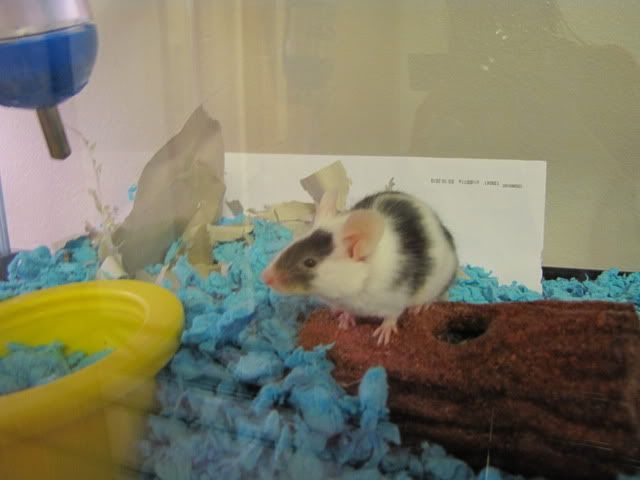 |
Mortimer in his cage with blue carefresh, some paper, an alfalfa log, a food dish, and an on-demand water bottle. |
The Cage
Mice don't need a lot of space. A ten gallon glass aquarium is the perfect size for a pair of mice. I prefer glass because the mice can't kick out bedding and can't escape easily. However, you need to be careful with a glass tank because the ammonia levels (from the mouse's waste) can get high before you even smell a dirty tank. If you go with a typical rodent cage, make sure the mice can't squeeze through the bars. All cages should have a tight fitting lid and be free of holes to prevent any possible rodent escapes.
Bedding
You are going to hear this one a lot when I talk about my animals: If money wasn't an issue, I would use bright blue care fresh. It is a very absorbent bedding. It is pretty, and it absorbs odors pretty well. To save money, I use shredded paper instead (from my paper shredder). It does a pretty good job of absorbing waste and odors (not nearly as good as the care fresh), but it is free. I use enough to cover the bottom of the cage with about 1/2 in of bedding.
Toys
Mice are very playful, active creatures. They love to run on wheels and climb on things. I provide my mice with a wheel to run in, wooden blocks (packaged for rodents) to chew on, and toilet paper tubes and cardboard boxes to hide in. I love giving my mice toilet paper tubes because they are free and they can be thrown away. Anything in the mouse cage that doesn't get thrown away should be sanitized weekly. Which brings me to my next point...
Cleaning
Mice are messy! I clean my cage out once weekly with a bleach solution. You don't have to do this. You can change the bedding about once every week to two weeks, and completely clean the cage once a month. But I like to have a clean cage, so I throw it in the shower and hose it down (we have a detachable shower head, which makes cleaning up after animals a snap) once a week. I just put a splash of bleach in the cage with about a gallon of water and rinse it well.
Handling
You can handle your mouse often. The best way to pick them up (if they don't crawl into your hand) is to shoo them into a toilet paper tube, pick up the tube, and tilt the tube slightly so that the mouse crawls into your palm. A faster way to pick up a mouse is to grab it by the base of the tail (this is very important: Grab it by the base. If you grab it by the tip of the tail it could break off), and lift the mouse gently, supporting its body with your other hand. Unless you have a particularly mean mouse, your mouse shouldn't bite. It will, however, poop and pee in your hand. Be prepared for that :) As with any animal, it is always a good practice to wash your hands before and after holding your pet. It is especially important with mice to wash your hands after because their feces can carry salmonella.
 | |
| Millie and I demonstrating the proper technique to pick up a mouse by the tail. |
 |
| Gently pinch both sides of the tail and lift up. |
Breeding
I currently own a breeding pair of mice. They pretty much take care of things on their own. The mama mouse will have about 2-6 babies(sometimes more) in a litter every 28 days or so. Mice can get pregnant soon after giving birth (within 24 hours), so it is important to take out the male if you do not want her getting pregnant again. The male can be in the cage with the pregnant female and the babies. Male mice are pretty uninvolved fathers, but they typically don't hurt the babies. Fair warning: The mama mouse may try to eat her babies. Unfortunately, this is just something that mice do. If your mama mouse tries to eat her babies, you can try making her environment calmer (reduce noise, put a blanket over the cage, don't touch the mice, etc). Also, you should make sure she is getting enough to eat (yes, some mice will eat their babies if they are starving). As my old boss told me, having babies is a learning process. Usually by the second or third litter, your mamma mouse will stop this behavior. Millie (my mouse) is a good mom. She has never tried to eat her babies. She will usually eat any stillborn babies (which is a great behavior).
Questions
Q: Do Mice Smell Bad?
A: The short answer is yes, mice are stinky. Male mice are smellier than female mice. If you have a breeding pair (like I do), your cage will be even smellier. But a single female mouse or a pair of female mice are not that stinky. A glass aquarium is the best cage for keeping the smell in.
Q: Do mice make good pets for children?
A: Yes. Mice make very good pets for older kids! I like mice a lot more than dwarf hamsters, which can be more timid and are more likely to bite (from my experience). Like many pets (including cats and dogs!), mice can carry diseases, so it is important to have your children wash their hands after handling their pet. It is also a good idea to monitor small children with mice (just like with any other pet). I won't recommend an age because all children are different in their maturity. If your child is old enough to calmly and gently hold a mouse, and will not try to put any mouse fecal pellets in his/her mouth, then a mouse would make a great pet.
Q: What about diseases? Aren't mice disease-ridden creatures?
A: It is true that wild mice can carry a number of nasty diseases including Hantavirus, Rabies, Leptospirosis, and the plague. However, pet mice don't usually carry these diseases. It is important to buy a healthy mouse from a pet store or a breeder (Wild mice make really bad pets)! The most common disease that a pet mice can carry is salmonella, which can be avoided with good hand-washing procedures.
Q: I own a cat. Can I have a mouse?
A: Yes. We own a cat, and he has no problem sharing his space with a pair of furry little rodents. Okay, so in reality, Dib (like any cat) would probably eat the mice if he got the chance. But we don't give him the chance. Our mice are in a glass aquarium with a tight-fitting lid. They are also up higher, where the cat can't really see them. As an extra precaution, our cat isn't allowed in the office room (where the mice are kept) when we aren't home. Depending on your cat, you might not need to follow all of these precautions. Most cats will leave the mice alone, as long as the rodents are kept in a cage with a lid. Dib doesn't even notice the mice until they are placed right in front of him. So if you own cats, mice, and children, you might want to supervise their interactions (and tell your little ones that showing the mouse to the cat probably isn't the best idea). Other than that, a tight-fitting lid should keep your kitty from turning your furry rodents into a furry dinner.
Q: How do I tell a sick mouse from a healthy mouse when picking one out at the pet store?
A: You would think that pet stores would sell quality mice. Not true! Many of the mice they sell are sick, injured, or dehydrated. A healthy mouse should have clear, bright eyes. She shouldn't walk with a hunched back, and she should be free from any lumps. Her fur should be clean and soft. Mice do scratch themselves quite a bit, but avoid any mouse that seems to be scratching excessively, or has irritated-looking skin.
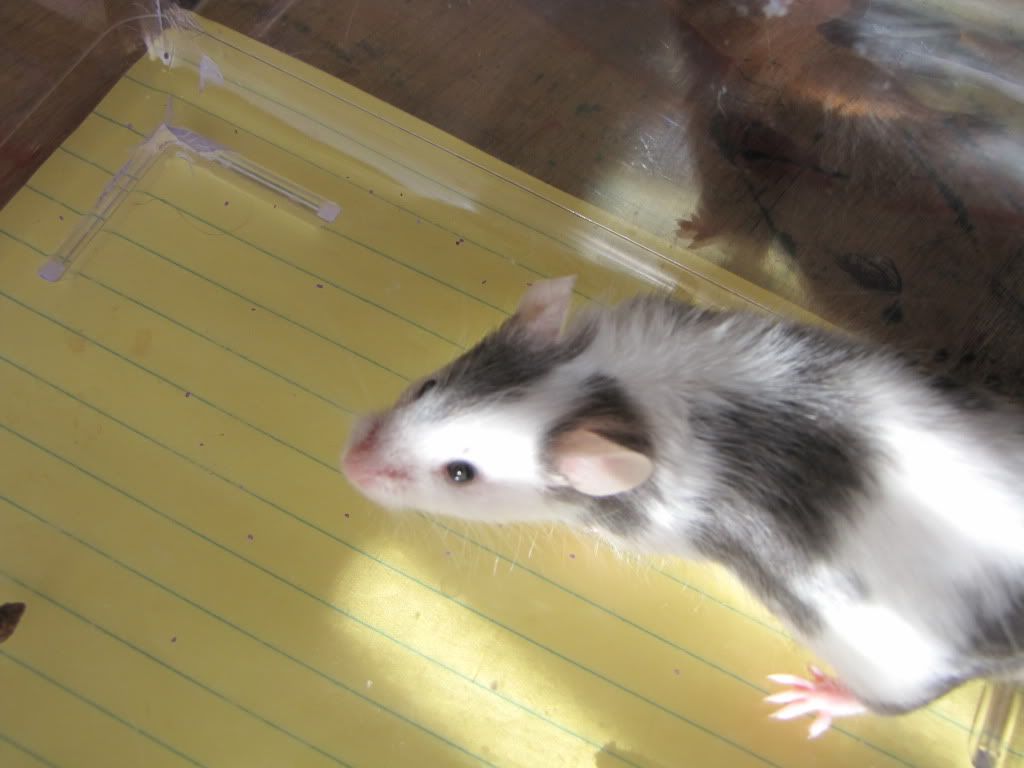
Millie has bright, clear eyes.
Q: Your mice are so pretty! All the mice at my local pet store are white and boring. Where can I find a pretty mouse?
A: Many big pet stores (like Petco and Petsmart) only sell black, white, and brown mice. The best place to look for a pretty patterned mouse is at a smaller pet store. You can also look into buying your mouse from a breeder.
That is it for this post about mice! If you have any questions, feel free to ask. Stay tuned for information on the care of corn snakes, king snakes, giant salamanders, african clawed frogs, pacman frogs, and leopard geckos.
Saturday, July 23, 2011
French Dip Sandwiches
I found another recipe appropriate for two people. Slow Cooker French Dip Sandwiches! This recipe makes about 3-4 sandwiches. My husband and I had two sandwiches each. If you want to increase this recipe for a family of four, I suggest getting a 3 lb roast and increasing the cooking time to about 6 hours. A cool thing about this recipe is that the left over cooking liquid can be used to make French Onion Soup! Unfortunately, it is a little too hot for me to make right now. If I do end up making it, I will post the recipe here :)
Ingredients:
1 1.5 lb rib roast (Every 1.5 lbs of roast makes 3-4 sandwiches)
1 jar of Better than Bouillon Au Jus Base (amount depends on roast size and slow cooker size)
Sandwich Rolls (4 for every 1.5 lbs of roast)
Water (enough to cover roast)
I made the roast early in the morning because I didn't want to leave the slow cooker going while I was gone. After the meat was sliced, I put it back in the slow cooker and put the crock in the fridge. When it was time for dinner, I put the crock back in the slow cooker and heated the meat back up. So this recipe can easily be made ahead of time.
Ingredients:
1 1.5 lb rib roast (Every 1.5 lbs of roast makes 3-4 sandwiches)
1 jar of Better than Bouillon Au Jus Base (amount depends on roast size and slow cooker size)
Sandwich Rolls (4 for every 1.5 lbs of roast)
Water (enough to cover roast)
- Trim any excess fat off of the roast.
- Add enough water to just cover the roast (measure the water as you add).
- For every 3/4 cup of water, add 1 tsp of the au jus base. Stir the liquid until the base dissolves
- Add the roast to the slow cooker.
- Cook the roast on low for about 3 hours.
- Take out the roast and check to make sure its internal temp has reached 145 degrees F.
- Let the roast cool on a cutting board for a few minutes, or until cool enough to slice.
- Slice the meat into thin pieces.
- Add the pieces back into the slow cooker and continue to heat on low for about 30 minutes.
- Make sandwiches with the meat, and serve the cooking liquid on the side for dipping. Enjoy!
I made the roast early in the morning because I didn't want to leave the slow cooker going while I was gone. After the meat was sliced, I put it back in the slow cooker and put the crock in the fridge. When it was time for dinner, I put the crock back in the slow cooker and heated the meat back up. So this recipe can easily be made ahead of time.
Subscribe to:
Posts (Atom)